History is written by survivors, conquerors, and record-keepers—but not all civilizations had written language, preserved texts, or documented archives. Some of the most influential human societies shaped the world without leaving written records. Their knowledge, culture, and influence survive only through artifacts, architecture, myths, genetic traces, and oral traditions.
These lost civilizations challenge the idea that history only belongs to those who wrote it. In reality, many advanced societies existed, evolved, and disappeared without leaving direct written evidence—yet their impact remains deeply embedded in human development.

History Is Incomplete by Design
What we call “history” is not the full story—it is the recorded story. Entire civilizations existed beyond documentation. Natural disasters, climate change, invasions, migrations, and time erased their records.
What remains are:
- Stone structures
- Burial sites
- Tools
- Artifacts
- Genetic traces
- Oral legends
- Cultural patterns
These fragments tell stories without words.
Civilizations Without Writing Systems
Many societies were highly advanced but did not use written language. Instead, they relied on:
- Oral traditions
- Symbol systems
- Art
- Rituals
- Memory-based knowledge transfer
- Cultural storytelling
Knowledge was preserved in people, not paper.
Advanced Knowledge Without Books
Lost civilizations demonstrated:
- Agricultural mastery
- Astronomical knowledge
- Engineering skills
- Medical understanding
- Urban planning
- Spiritual systems
- Trade networks
- Navigation techniques
All without formal writing systems.

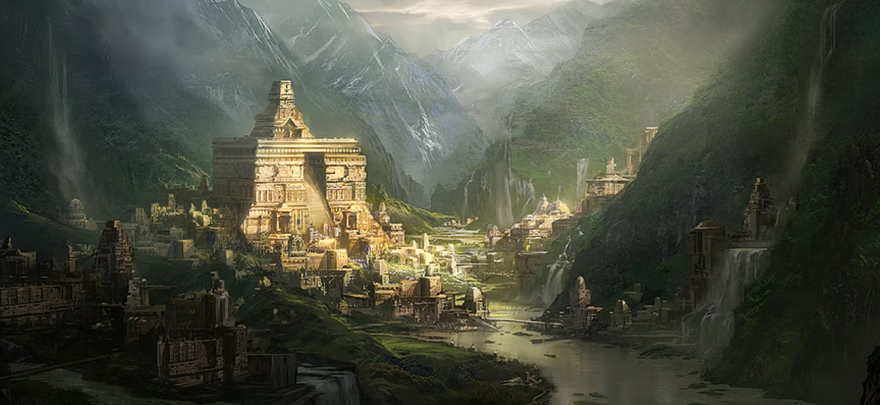
Architecture as a Historical Record
Stone structures act as silent historians. Cities, temples, pyramids, and monuments reveal:
- Mathematical knowledge
- Engineering precision
- Astronomical alignment
- Social hierarchy
- Spiritual beliefs
- Political systems
Architecture became their language.
Oral Knowledge Systems
Some civilizations passed knowledge orally for thousands of years. Stories were encoded with:
- Environmental wisdom
- Survival knowledge
- Moral laws
- Cultural values
- Medical practices
- Astronomical cycles
Memory replaced manuscripts.
Cultural DNA and Human Migration
Modern populations still carry genetic markers from lost civilizations. Their influence survives through:
- Language structures
- Traditions
- Rituals
- Art styles
- Agricultural methods
- Music patterns
- Spiritual beliefs
Their legacy lives in living people.
Why These Civilizations Disappeared
Common reasons include:
- Climate collapse
- Natural disasters
- Resource depletion
- Invasions
- Disease outbreaks
- Internal collapse
- Environmental changes
Civilizations don’t vanish overnight—they fade slowly.
The Knowledge We May Never Recover
Lost civilizations may have possessed:
- Medical knowledge
- Energy systems
- Astronomical understanding
- Natural medicine systems
- Engineering techniques
- Sustainable technologies
Much of this knowledge disappeared with them.
Why They Still Matter Today
These civilizations prove that:
- Intelligence existed before modern science
- Knowledge doesn’t require writing
- Advancement doesn’t require technology
- Wisdom existed without machines
- Culture shapes progress
- Humanity has risen and fallen many times
Modern society is not humanity’s first peak.
Rethinking Human History
Lost civilizations force us to question:
- Linear history models
- Modern superiority narratives
- Technological arrogance
- Civilizational dominance theories
- Cultural hierarchies
Human history is cyclical, not linear.
Final Thoughts
Not all greatness is recorded. Not all knowledge is written. Not all civilizations leave books behind. Some leave influence instead.
Their cities may be gone.
Their languages forgotten.
Their names erased.
Their records lost.
But their impact remains—in culture, in genes, in traditions, in knowledge systems, and in humanity itself.
History is not just what we remember.
It is also what we have forgotten.
And sometimes,
the greatest civilizations are the ones
we never learned about.